

If you own a UK business and want to continue living and working in the UK, you may have heard of the Self-Sponsorship Skilled Worker Visa.
The first thing to understand is that self-sponsorship is not a separate UK visa category.
Instead, self sponsorship UK is a term commonly used to describe a situation where a person has, or establishes, a genuine UK business which obtains a Skilled Worker sponsor licence and then sponsors them for a genuine eligible role within that business.
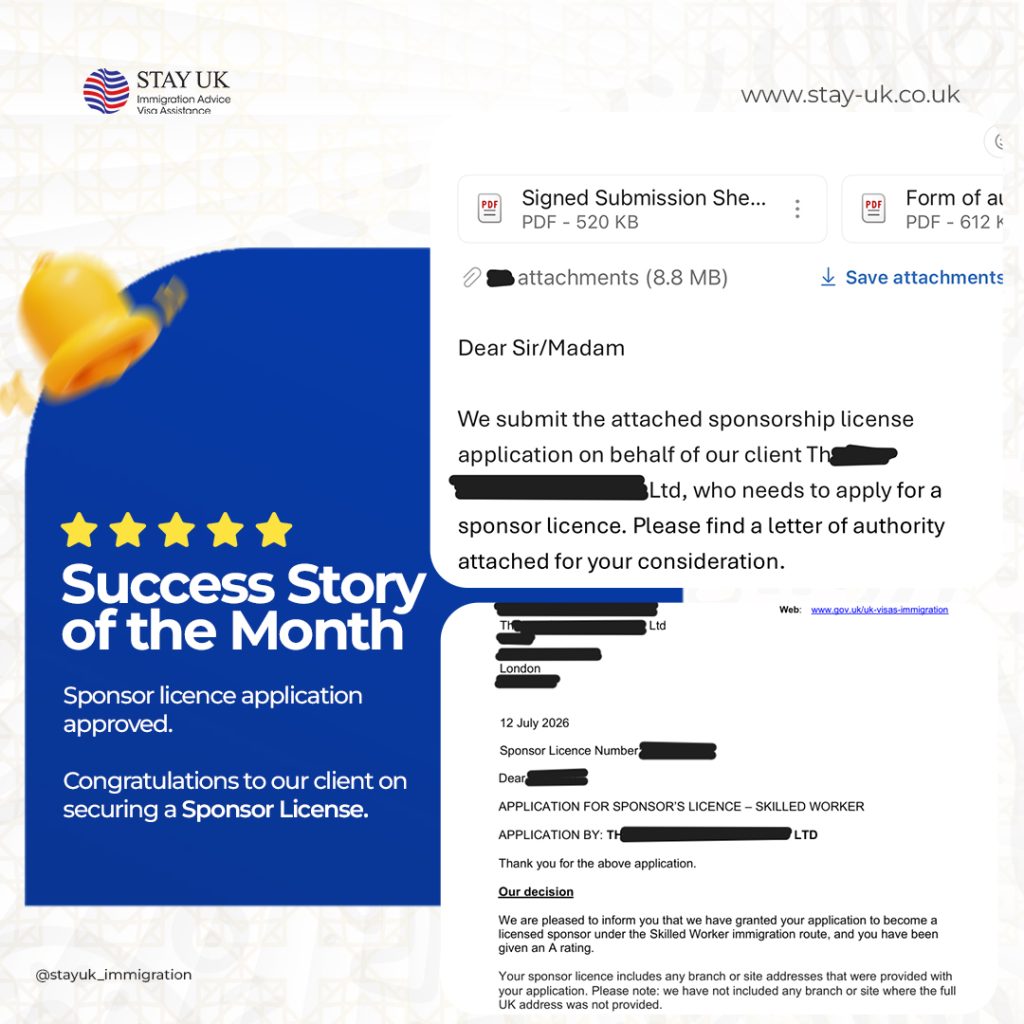
At Stay UK, we have successfully assisted with self-sponsorship-related Skilled Worker applications both before and after July 2025, including businesses in areas such as toy production, cleaning, butchery and care homes.
However, the Self-Sponsorship Skilled Worker Visa process is not simple and is not suitable for every business.
Self-Sponsorship Skilled Worker Visa: Your Business Must Be Genuine
Before a business can sponsor a Skilled Worker, it must meet the Home Office’s requirements for a Skilled Worker sponsor licence.
The Home Office will consider whether the organisation is genuine and operating or trading lawfully in the UK, whether it is suitable to hold a sponsor licence and whether it can comply with its sponsorship duties.
This means that simply registering a company at Companies House is not enough.
Your business may need to demonstrate that it is genuinely trading or operating, properly registered where necessary and complying with relevant legal and regulatory requirements.
The Home Office has also strengthened its guidance around organizations that appear to have been established mainly to facilitate someone’s immigration rather than to operate as a genuine business.
What Does “Operating or Trading” Actually Mean?
There has been an important development in the sponsor licence guidance that business owners considering the UK self sponsorship visa route need to understand.
On 20 May 2026, the Home Office introduced a formal definition of “operating or trading” into the Workers and Temporary Workers sponsor guidance glossary.
The requirement for a sponsor to be operating or trading in the UK was already important, but the Home Office has now provided greater clarity about how this is assessed.
“Trading” broadly involves commercial activity where goods or services are provided to customers in return for payment.
“Operating” can also include charities and other not-for-profit organisations providing services to clients or service users, as well as businesses undertaking genuine pre-trade activities with a view to commencing commercial trading.
This is particularly important for new businesses and businesses that are still developing. Being newly established or not yet generating substantial revenue does not necessarily mean that a business cannot qualify. However, the business must be able to demonstrate genuine operational activity and credible commercial plans.
The Home Office Is Looking More Closely at Genuine Trading
The May 2026 guidance also gives examples of circumstances where the Home Office is unlikely to be satisfied that an organisation is genuinely operating or trading.
For example, where a business has little or no evidence of financial transactions with customers, clients or service users, and most of its funding comes from a related company or private investors, the Home Office may conclude that there is insufficient evidence of genuine trading.
The guidance also addresses “circular trading.”
If invoices and contracts are mainly between businesses connected through common ownership, control or personnel, with little or no evidence of providing services to genuine external customers, the Home Office may conclude that there is no meaningful operating or trading activity.
This is particularly relevant to people considering a business structure primarily because they need Skilled Worker sponsorship.
Your Business Must Exist for More Than Immigration Purposes
There is another significant change.
The Home Office guidance now provides for refusal where there are reasonable grounds to consider or suspect that an organisation was established, or exists, mainly to facilitate the entry or residence of a person who would not otherwise have permission to work in the UK.
This reinforces an important principle of the Self-Sponsorship Skilled Worker Visa strategy: the business must be genuine in its own right.
The business should not simply be a vehicle created to obtain a visa. It needs to have a genuine commercial purpose, operate lawfully, have genuine business activity and be capable of meeting its responsibilities as a sponsor.
This is why we strongly recommend that anyone considering self-sponsorship gets advice long before applying for a sponsor licence.
The Home Office can also conduct compliance checks before deciding a sponsor licence application and after a licence has been granted.
A successful sponsor licence application is therefore not the end of your responsibilities. You must continue to operate your business lawfully and comply with your sponsor duties.
If you are considering self-sponsorship, give yourself enough time to build the business, gather evidence and prepare properly. Do not wait until your current visa is about to expire before starting the process.

You Need a Genuine Eligible Job
Your business cannot simply create a job title so that you can obtain a visa.
The role you intend to sponsor must be a genuine eligible role under the Skilled Worker route.
You will need to consider the duties of the position, the appropriate occupation code, the required skill level and the applicable salary requirements.
The Home Office also considers whether the proposed employment is genuine and whether the business has a credible need for the role.
This is why the business structure, your proposed role and the evidence supporting the application need to make sense together.
Can Your Business Afford to Pay Your Salary?
This is another area that should not be overlooked when considering a sponsor licence for business owners.
If your company is going to sponsor you, it needs to be capable of sustainably paying the required salary.
You should therefore consider your business’s income, expenses, cash flow, future revenue and available funds, rather than looking only at the money currently sitting in the business bank account.
The business needs to be financially sustainable and capable of meeting its employment and sponsorship obligations.
The Home Office may also carry out checks to determine whether sponsored workers are actually being paid in accordance with the requirements.
You Need to Comply With Immigration and Employment Law
A business that sponsors a Skilled Worker takes on significant responsibilities.
You need appropriate systems for:
- Right-to-work checks;
- Keeping appropriate employee and immigration records;
- Reporting relevant changes to UKVI;
- Monitoring sponsored workers;
- Paying the required salary;
- Complying with sponsor duties; and
- Ensuring the sponsored role and employment remain genuine.
Your business must also comply with relevant UK employment law, not simply immigration law.
This is particularly important because obtaining the sponsor licence is not the end of the process.
Step 1: Apply for a Skilled Worker Sponsor Licence
The first stage of a Self-Sponsorship Skilled Worker Visa strategy is for the business to apply for a Skilled Worker sponsor licence.
The application involves submitting the online application, paying the relevant Home Office fee and providing supporting documents and information about the business.
The Home Office will assess whether the organisation is suitable to become a sponsor and whether it has the systems and people required to manage sponsorship.
The business will also need appropriate Key Personnel to manage the sponsorship licence through the Sponsor Management System.
Depending on the circumstances, these roles can include:
- Authorising Officer;
- Key Contact;
- Level 1 User; and
- Level 2 User.
The requirements applying to the people appointed to these roles should be considered carefully when preparing the application.
Step 2: Compliance Checks Can Happen Before or After Approval
One of the biggest mistakes business owners can make is assuming that once the sponsor licence has been approved, everything is finished.
It isn’t.
UKVI can conduct a compliance check before making a decision on your sponsor licence application or after the licence has been granted.
Compliance checks may also take place on an unannounced basis.
This is why your business needs to be ready to demonstrate that it is genuinely operating and that you understand and are complying with your sponsor duties.
What Happens After the Sponsor Licence Is Approved?
Once your sponsor licence is approved, the business can use the Sponsor Management System to assign a Certificate of Sponsorship (CoS) for an eligible role.
You can then make your Skilled Worker visa application based on that sponsorship.
The visa application itself must still meet all the relevant Skilled Worker requirements.
A sponsor licence does not automatically mean that the Skilled Worker visa will be granted.
Do Not Leave Self-Sponsorship Until Your Visa Is About to Expire
This is one of the most important pieces of advice we give to business owners considering the Self-Sponsorship Skilled Worker Visa route:
Start early.
Do not wait until a few weeks before your current visa expires before thinking about sponsor licensing and self-sponsorship.
You need time to:
- Assess whether your business is suitable;
- Make sure the business is properly registered and operating;
- Gather the necessary evidence;
- Prepare the sponsor licence application;
- Deal with any Home Office queries or compliance checks;
- Obtain the sponsor licence;
- Assign the appropriate Certificate of Sponsorship; and
- Prepare and submit the Skilled Worker visa application.
A rushed application can create unnecessary risks.
Book a Consultation Before You Start
Before applying for a sponsor licence, we recommend having your circumstances assessed so that you understand:
- Whether your business is likely to meet the sponsor licence requirements;
- Whether your proposed role is suitable for Skilled Worker sponsorship;
- What evidence you need to gather;
- Whether your business can support the required salary;
- What your sponsorship compliance responsibilities will be; and
- Whether this is the right immigration strategy for you.
If your current visa is approaching expiry, don’t wait until the last minute.
Book a consultation with Stay UK to discuss your business and immigration options and give yourself enough time to prepare properly.
This article is for general information only and does not constitute legal advice.