
3 November 2026
The Government has confirmed major changes to the way migrants will qualify for Indefinite Leave to Remain in the UK under its new “Earned Settlement” system.
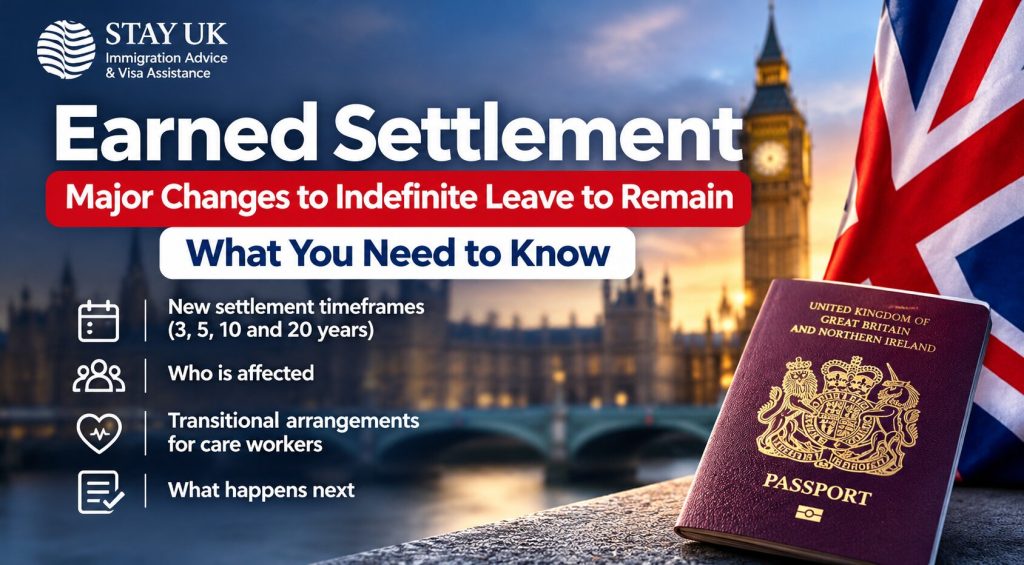
Following the consultation launched in November 2025 , the Home Secretary announced further details of the reforms on 2 November 2026. The Government has confirmed that the current five-year route to settlement will no longer be the standard route for most migrants. Instead, the default qualifying period will increase to 10 years, with some people able to qualify sooner depending on their earnings, occupation and contribution to the UK.
Importantly, the reforms have not yet been implemented into the Immigration Rules. Further changes to the Immigration Rules and technical guidance are still required before the new system takes effect.
What is Earned Settlement?
Under the current system, many migrants on routes such as Skilled Worker can qualify for ILR after completing five years of continuous lawful residence and meeting the relevant requirements.
Under Earned Settlement, residence alone will generally no longer determine when a person qualifies.
The Government intends to assess settlement by reference to factors including an applicant’s character, integration, contribution and residence.
The starting point for most migrants will be 10 years, but that period may be shorter for certain groups who meet specified contribution criteria.
Who could qualify for settlement after three years?
A three-year route is expected to apply to:
- individuals who have earned at least £125,141 per year for the previous three years; and
- migrants on certain “high talent” routes, including Global Talent, Innovator Founder and International Sportsperson.
This represents the fastest route to settlement under the proposed new framework.
Who could continue to qualify after five years?
A five-year route will remain available to several groups.
This includes individuals who have earned at least £50,271 per year for the previous three years.
Certain workers in qualifying public service occupations will also remain eligible for a five-year route. This is expected to include specified occupations in healthcare and education, such as doctors, nurses and teachers.
People with certain British connections, including partners and parents of British citizens and people on the UK Ancestry route, are also expected to retain their existing settlement periods.
Other groups, including Hong Kong BN(O) status holders, members of HM Armed Forces and certain vulnerable groups, will continue to benefit from their existing settlement arrangements.
The new standard route: 10 years
For most other migrants, the standard qualifying period for settlement will become 10 years.
This means that many Skilled Workers who would currently expect to qualify for ILR after five years could potentially have to wait 10 years unless they fall within one of the categories eligible for an accelerated route.
The Home Secretary specifically confirmed that the 10-year route will include those earning below the relevant £50,000 threshold.
Migrants affected by the longer qualifying period are expected to be able to continue extending their temporary permission until they become eligible for settlement.
New mandatory requirements for settlement
Completing the relevant qualifying period will not, by itself, be sufficient.
The Government has confirmed a number of mandatory requirements that applicants will have to satisfy before settlement can be granted.
These include:
- meeting stricter criminality and character requirements;
- meeting an English language requirement at B2 level;
- having no relevant outstanding debt owed to the Government;
- passing the Life in the UK Test; and
- demonstrating sustained contribution, including the required National Insurance contribution history.
The Home Secretary’s statement referred specifically to a requirement for three years of National Insurance contributions.
The precise operation of these requirements, including applicable exemptions, will need to be confirmed in the Immigration Rules and accompanying guidance.
Important transitional protection for care workers
One of the most significant announcements concerns care workers who came to the UK before the Immigration White Paper was published in May 2025.
The Government has decided not to place all existing care workers automatically onto the new 10-year route.
Care workers who satisfy the relevant Skilled Worker settlement conditions, including the applicable sponsorship requirements and earning at least £25,000 per year, will be able to remain on a five-year route to settlement.
This is an important change from the proposals previously under consideration.
However, care workers who do not satisfy those conditions will not necessarily qualify for settlement after their existing five years.
Instead, the Government intends to give this group a further opportunity to qualify. They will be able to apply for a further five-year care visa and, importantly, this visa will not be tied to their previous employer.
If they meet the relevant requirements at the end of that additional period, they may then qualify for settlement.
Similar transitional arrangements are expected to apply to certain public sector workers in healthcare and education who entered the relevant routes before the publication of the Immigration White Paper in May 2025.
What happens to people already in the UK?
This remains one of the most important aspects of the reforms.
The Government has confirmed that settlement rules are generally determined when the settlement application is decided, rather than when the migrant first entered the UK.
This means that being granted a visa under rules which currently provide a five-year route to settlement does not necessarily guarantee that the current five-year settlement rules will still apply when the person eventually applies for ILR.
The Government’s response does provide specific transitional protection for some groups, particularly certain care, health and education workers. However, there is no general protection preserving the existing five-year route for everyone who is already in the UK.
Anyone who already holds ILR or settled status will not lose that status as a result of these reforms.
What about dependants?
The Government has recognised concerns about the position of families and dependants and has indicated that specific provisions will be included for families.
However, the final Immigration Rules will be particularly important in determining how qualifying periods will operate for dependent partners and children, including circumstances where the main applicant becomes eligible for settlement earlier because of earnings or occupation.
Applicants should therefore avoid assuming that the qualifying period applicable to the main applicant will automatically apply in exactly the same way to every dependant until the detailed Rules are published.
Immigration breaches could result in a 20-year route
The reforms will introduce significantly tougher consequences for previous breaches of immigration law.
Under the announced framework, a person who has committed an immigration breach could face a 20-year qualifying period for settlement.
Relevant breaches are expected to include matters such as overstaying, breaching visa conditions, deception in an immigration application and frustrating immigration control.
Significantly, positive factors such as higher earnings may not necessarily reduce the 20-year period where the immigration breach provisions apply.
The precise definitions and exceptions will therefore be extremely important once the Immigration Rules are published.
What if someone has claimed benefits?
The Government has also confirmed that access to public funds may affect when a person can qualify for settlement.
The Home Secretary stated that those who have claimed benefits will need to demonstrate five continuous years without reliance on public funds before applying for settlement.
Again, the detailed Immigration Rules will be required to establish exactly which benefits, periods and exemptions will be covered.
Major changes to the 10-year Long Residence route
Another significant proposal is the closure of the existing 10-year Long Residence route to ILR.
Under the new system, not every category of lawful residence in the UK will count towards settlement.
Time spent on routes including the following is not expected to count towards the new qualifying period:
- Student;
- Graduate;
- Visit;
- Youth Mobility;
- Global Business Mobility;
- Temporary Worker;
- Seasonal Worker;
- High Potential Individual; and
- certain other temporary routes.
This could have a substantial impact on people who have spent many years lawfully in the UK across different immigration categories and who would currently expect eventually to rely on the 10-year Long Residence route.
The Government also intends to restrict the ability to combine residence accumulated under fundamentally different settlement pathways. For example, time accumulated on certain work or family routes may not necessarily be combined with time on protection or human-rights routes.
The final Immigration Rules will be essential to understanding exactly how previous residence will be treated.
What about the EU Settlement Scheme?
The EU Settlement Scheme is outside the Earned Settlement reforms.
People qualifying for settled status under Appendix will therefore not be moved onto the new 10-year Earned Settlement model.
This distinction is important because settled status under the EU Settlement Scheme and ILR obtained under other parts of the Immigration Rules are governed by different legal frameworks.
Changes for refugees
The Government has also announced substantial changes to settlement for refugees.
Refugees entering through designated safe and legal routes are expected to have a five-year route to settlement.
For refugees who did not arrive through a safe and legal route, the standard qualifying period is expected to become 20 years.
An additional 10 years may apply where a person entered the UK illegally, potentially resulting in a 30-year route to settlement.
The Government has indicated that refugees who move into qualifying work, education or training may be able to access a shorter pathway through the proposed Protection Work and Study route.
When will the new settlement rules start?
The most important point for applicants currently approaching settlement is that these announcements do not, by themselves, change the Immigration Rules.
The Government has confirmed the policy framework, but the detailed legal provisions still need to be introduced.
Further technical guidance and an impact assessment are also expected before implementation.
The current indication is that a Statement of Changes to the Immigration Rules is expected in December 2026, with implementation taking place during 2027.
Until the Immigration Rules actually change, applications continue to be considered under the rules in force at the relevant time.
What should migrants do now?
People who are already eligible, or will shortly become eligible, for ILR should check their position carefully rather than assuming that the announced changes already apply to them.
Equally, migrants who are several years away from settlement should not assume that the qualifying period stated when their current visa was granted will necessarily remain unchanged.
The final Statement of Changes will be particularly important because it should confirm the commencement dates, transitional arrangements, qualifying residence, treatment of dependants, salary calculations, National Insurance requirements and how the new rules will apply to people already in the UK.
For care workers in particular, it will be important to establish when they entered or switched into the route, their current sponsorship position and salary, as these factors could determine whether they retain a five-year route or require a further period of permission before qualifying for settlement.
Conclusion
Earned Settlement represents a fundamental change to the UK’s settlement system.
For most migrants, the familiar five-year route to ILR is expected to be replaced by a 10-year starting point, while higher earners, people on high-talent routes, certain public service workers and people with particular British connections may continue to qualify sooner.
The Government has also confirmed important transitional arrangements for certain care workers and public sector workers who were already in the immigration system before the May 2025 Immigration White Paper.
However, the announcement is not yet the Immigration Rules. The detailed legal framework will determine exactly who is affected, when the changes begin and what transitional protection will apply.
Anyone approaching settlement should therefore obtain advice based on their individual immigration history before making decisions about extending their visa or applying for ILR.
Need advice about how the Earned Settlement changes could affect you?
If you are currently on a Skilled Worker, Health and Care Worker or another route to settlement, these proposed changes could affect when you become eligible for Indefinite Leave to Remain.
The position will depend on your individual circumstances, including when you entered your current immigration route, your salary, occupation, immigration history and whether any transitional arrangements apply to you.
At Stay UK, our IAA-regulated immigration advisers can assess your circumstances and advise you on your current route to settlement and how the proposed changes may affect your eligibility for ILR.
Book a consultation with Stay UK to discuss your immigration status and settlement options.
Stay informed. Stay prepared. Stay UK.
This article is for general information only and does not constitute legal advice. The Earned Settlement proposals discussed above have not all been implemented into the Immigration Rules and may be subject to further changes.